- 1
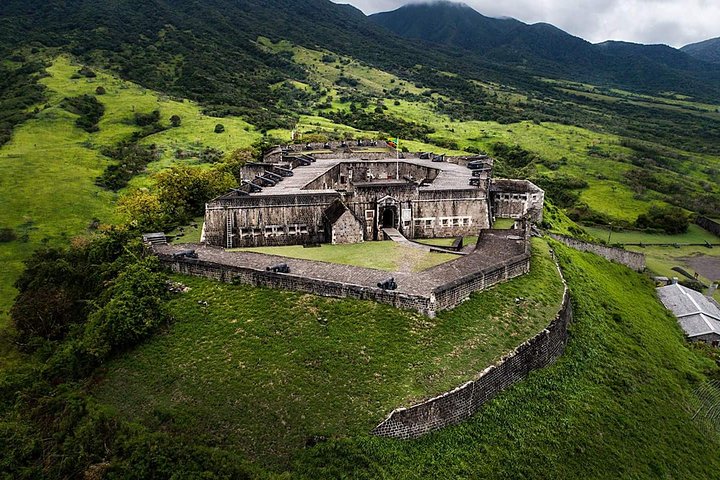
Brimstone Hill Fortress National Park
The Fortress, built between the 1690s and 1790s, stands as a significant remnant of an 18th-century military community, offering a unique historical perspective.
This prominent Citadel showcases an early and well-preserved example of the 'polygonal system' of fortification.
Brimstone Hill, nearly 800 feet high, features steep slopes engineered with remarkable skill and architectural prowess.
The fortress walls are primarily constructed from the hard volcanic rock of the hill, with mortar made from on-site limestone.
The Fortress appears as a natural extension of the hill itself, a testament to human ingenuity.
Its elevated position provides stunning panoramic views of forested mountains, historic Sandy Point, and neighboring islands across the Caribbean Sea.
· 25 min· Admission included
- 2
Black Rocks
Black Rocks, also known as Black Stone, is a distinctive rock formation on St. Kitts' northeastern coast, near Saddlers.
These rocks are the result of lava flow from the volcanic Mount Liamuiga, which dominates the northern part of the island.
· 10 min
- 3
Romney Manor
These grounds, spanning approximately 8 acres, possess a rich history dating back to the 1600s.
Evidence suggests a village belonging to Carib Indian Chief Tegreman occupied the site before European settlement.
The estate has a long history of sugar cane cultivation and distillation, utilizing animal, water, and steam power for over 350 years.
In the 1920s, sugar processing centralized in Basseterre, leading the Wingfield Estate to focus on harvesting and shipping until the mid-2000s.
Romney Manor transformed into a batik enterprise in the 1970s under its current owner's guidance.
The Wingfield Estate began its evolution into beautiful gardens and an archaeological site in the 2000s after the St. Kitts government ceased sugar cane operations.
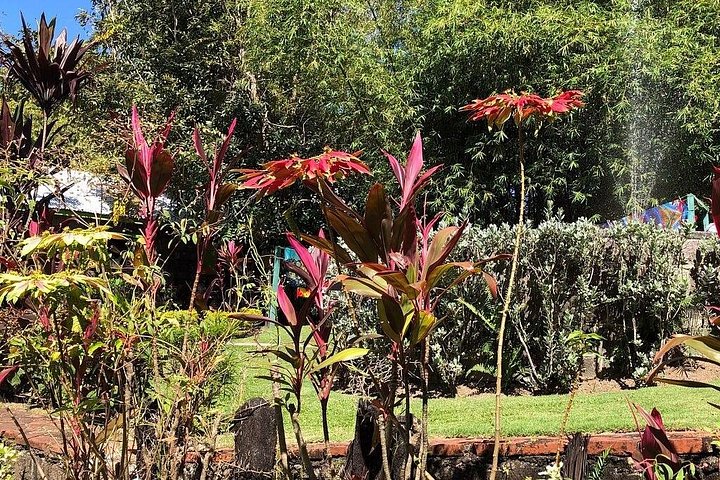
Many visitors experience a sense of spirituality in the gardens, particularly near the magnificent Saman tree, the island's largest living organism.
This ancient Saman tree, over 400 years old and covering half an acre, is a beloved feature, with many visitors returning to appreciate its presence.
· 15 min· Admission included
- 4
The Circus
The Berkeley Memorial, erected in 1883, was once the sole public monument in St. Kitts honoring an individual.
It commemorated Thomas Berkeley Hardtman Berkeley, a notable legislator and estate owner.
· Non-stop passage
- 5
Berkeley Memorial
The War Memorial, initially unveiled in 1926, stood where the Post Office is now located.
It served to honor the soldiers who lost their lives in World War I.
· Non-stop passage
- 6
Timothy Hill
Timothy Hill is a popular viewpoint offering a stunning vista where the Atlantic Ocean meets the Caribbean Sea.
From this vantage point, you can observe the lush, green landscapes and gentle hills of St. Kitts' southeast peninsula, with Nevis visible in the distance.
· 15 min
- 7
Wingfield-Phillips Rain Forest Nature Trail
Adjacent to the Wingfield River, this estate is nestled in a verdant rainforest within Old Road Town, St. Kitts.
The estate is situated in the scenic foothills of the island's central mountains, which rise over 3000 feet.
A significant feature is the Wingfield watershed, a natural resource covering hundreds of acres and supplying over three-quarters of the island's water needs.
Wingfield Estate is one of four locations on St. Kitts featuring 17th-century Amerindian petroglyphs, considered among the finest in the Lesser Antilles and easily accessible.
Local legend suggests that Carib Chief Tegreman, a powerful Amerindian leader, had his village on the grounds of Romney Manor.
Wingfield received the first land grant in the English West Indies in 1625, initially cultivating tobacco and indigo.
Sugar cane cultivation dominated the site for 350 years, from the 1650s to the mid-2000s.
The sugar industry employed animal, water, and steam power for crushing cane over the centuries, with water power used extensively from the 1600s to the 1920s.
· 15 min
- 8
Bloody Point
Bloody Point, located west of Challengers Village, derives its name from a historical massacre of the Kalinago people in the area.
· Non-stop passage
- 9
Saint Theresa Catholic Church, Charlestown
The Co-Cathedral of the Immaculate Conception, an ornate grey stone church, is situated on the eastern side of Independence Square.
Originally a Roman Catholic Church built by Jesuits during the French occupation, it was later rebuilt as St. George's Anglican Church after being burned in 1706.
The Catholic congregation in St. Kitts significantly declined after the Treaty of Utrecht, and public worship was forbidden by the English in 1713.
Wealthy Catholic families discreetly held services in their homes, with two such buildings still existing on Liverpool Row in Basseterre.
· Non-stop passage
- 10
The Pro Cathedral & Parish of St George with St Barnabas
St. George's Anglican Church, the largest church in Basseterre, is designed in the style of an English parish church with heavy andesite rock walls and a slate roof.
The church has a history of rebuilding after various incidents, much like other structures in Basseterre.
In 1635, Capuchin friars were assigned to minister to French colonists and attempt conversions among the remaining Kalinago population.
They established a place of worship in Basseterre, described as a substantial wooden structure.
The friars also had churches in Cayon and Capisterre, but were ordered to leave the colony in 1646 by Governor De Poincy, who replaced them with Jesuits.
The Jesuits constructed a church called Notre Dame in 1672.
· Non-stop passage
- 11
Independence Square
Formerly Pall Mall Square, Independence Square was renamed on September 19, 1983, to commemorate the establishment of St. Christopher and Nevis.
Located east of Basseterre, bordering Newtown, its design resembles a Union Jack.
The surrounding streets and houses, dating back to the mid-eighteenth century, have suffered damage from time and environmental factors.
Structures like the Court House and Public Library were rebuilt after being destroyed by fire.
· Non-stop passage
 Free cancellation
 Top pick
 Free cancellation
 Top pick
 Free cancellation
 Selling fast
 Top pick