- 1
Dashaswamedh Ghat
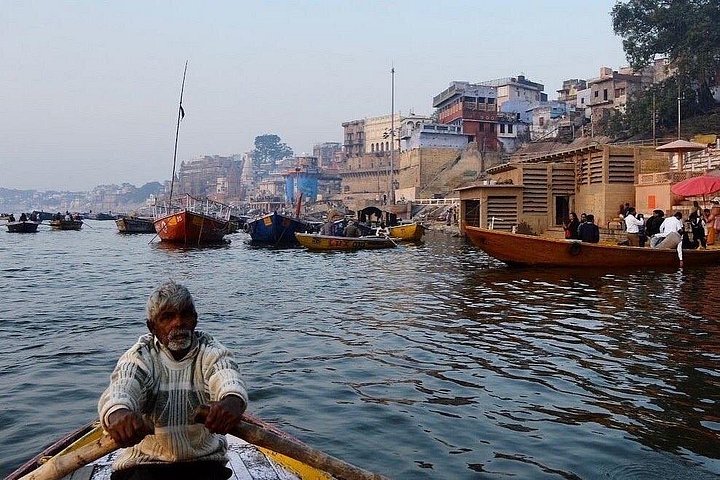
Dashaswamedh Ghat is one of the oldest, most spectacular, and important ghats, located on the bank of the River Ganges near the old Vishwanath Temple in Kashi. The literal meaning of Dashashwamedh is the Ghat (river front) of the ten sacrificed horses (Dash means 10, Ashwa means horse, Medh means sacrifice).
There are two mythologies about the ghat: one is that Lord Brahma created the Dashashwamedh Ghat to welcome Lord Shiva, and the second is that Lord Brahma sacrificed ten horses in a yajna here.
This ghat is famous for the Agni Pooja, which is held here daily in the evening by a group of priests dedicated to Lord Shiva, the River Ganges, Surya, Agni, and the whole universe.
· 10 min
- 2
Vishalakshi Temple
The Vishalakshi Temple, also known as Vishalakshi Gauri Temple, is one of the prominent temples of Varanasi dedicated to Goddess Vishalakshi. The Goddess Vishalakshi is an aspect of Goddess Parvati or Gauri and is believed to have large eyes, as the name also says ‘Vishalakshi = Vishal (big) + Akshi (eyes).’ It is located at Mir Ghat on the banks of the Ganga River.
The temple is considered a Shakti Pitha dedicated to the Hindu Divine Mother, Adi Shakti. This popular holy place in Varanasi is part of the famous triad of temples: Kanchi Kamakshi, Madurai Meenakshi, and Kashi Visalakshi.
It is believed that the earrings or kundal of Goddess Sati had fallen here.
· 15 min· Admission included
- 3
Nepali Temple (Kathwala Temple)
Shri Samrajeswar Pashupatinath Mahadev Mandir, also known as the Nepali Mandir or Kanthwala Mandir, is one of the oldest and most famous temples in the holy city of Varanasi. This temple holds great religious importance in Hinduism and is dedicated to Lord Shiva.
The mandir is made of terracotta, stone, and wood and took three decades to complete. The wood is termite-proof. It is constructed in the Nepali style of architecture and is surrounded by tamarind and Ficus religiosa (peepal) trees.
· 15 min· Admission included
- 4
Manikarnika Ghat
Manikarnika Ghat is famous for being the sacred cremation ground for Hindus. It is one of the holiest cremation grounds among the sacred riverfronts (Ghats) along the River Ganges. In Hinduism, death is considered a gateway to another life, marked by the results of one's karma. It is believed that a human's soul attains moksha, and hence breaks the cycle of rebirth, when cremated here.
The well at the ghat is called Manikarnika Kund and was built by Lord Vishnu.
· 25 min· Admission included
- 5
Manikarnikeshwar Mahadev
According to Lord Vishnu, devotees who bathe in Manikarnika and worship Manikarnikeshwar will not see their mother’s womb again (meaning there will be no rebirth).
The linga is located underground; devotees can go all the way down to have a darshan of Shri Manikarnikeshwar Mahadev.
· 10 min· Admission included
 -20%
 Top pick