- 1
Pancha Rathas
Make the first stop of the day at the Pancharathas, or five chariots, a series of monolithic temples built by the Pallavas.
These are rock cut monolith temples structures built in the 7th century.
Each of the 5 rathas or chariots are dedicated to the lead cast of the Mahabharat epic- Draupadi, Arjuna, Nakul-Sahadeva, Bhima and Yudhister.
There is also a sculpture of an elephant next to the ratha of Nakul-Sahadeva.
Once you stand towards the rear of the elephant you will notice that there is an uncanny resemblance between the rear of the chariot and the elephant.
· 25 min· Admission included
- 2
Arjuna's Penance
We next visit Arjuna’s Penace, a bas-relief monument that’s considered one of India’s most magnificent pieces of ancient art, depicting vivid scenes from the Mahabharata.
The relief is 100 feet long and 45 feet tall!
The main story being told is how Arjuna, one of the Pandava brothers, performed severe austerities in order to obtain Lord Shiva's weapon.
· 20 min· Admission included
- 3
Pancha Pandava Cave
Pandava cave is the largest cave-temple at Mahabalipuram.
The cave is supported on six pillars and two pilasters.
The highlight of the architecture are the spectacular sculptures of mythical creatures called Yali on the pillars.
· 15 min· Admission included
- 4
Krishna's Butter Ball
The next stop is Krishna’s Butterball, a granite boulder that’s poised on a stony slope.
This curious boulder seems to defy Newton's laws of gravity and has not moved an inch despite being in this precarious position on the slope for more than a thousand years.
· 15 min· Admission included
- 5
Varaha Cave Temple
The Varaha cave is carved out of huge piece of granite and dates back to the 7th century.
This temple took several decades to be completed.
There are squatting lions adorning the pillars which support the hall.
Another highlight are the sculptures of two guardian angels who protect the sanctum.
· 15 min· Admission included
- 6
Trimurti Cave
This cave is a fine example of the spectacular architecture style of the Pallavas.
The rock cut temple is dedicated to the holy trinity of Hindu Gods- Brahma, Vishnu and Shiva.
There are fine carvings of elephants as well.
· 15 min· Admission included
- 7
Shore Temple
This is a imposing chariot carved out of a single stone.
Originally dedicated to Lord Shiva, it now has the deity of his son Lord Ganesh.
It was built in the 7th century by King Mahendravarman I.
The other highlight of this temple are the 18 inscriptions in ancient grantha and nagari scripts of Sanskrit.
· 15 min· Admission included
- 8
Shore Temple
Built in the year 640, it is India’s oldest light house and one of the oldest in the world.
Mahabalipuram was a very busy port since the 7th century and hence this lighthouse played a significant role in keeping mariners safe.
· 15 min· Admission included
- 9
Mahishasuramardini Cave
Two of the most impressive works of art of Mahabalipuram reside in this cave.
It has 2 imposing bas-reliefs on the walls.
The first one is Lord Vishnu sleeping on top of the coils of a serpent.
The other is with Goddess Durga fighting with the demon Mahishasura on a lion.
· 15 min· Admission included
- 10
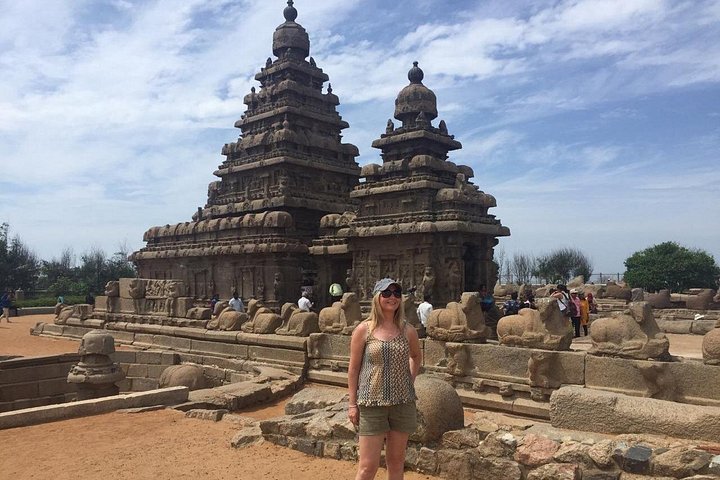
Shore Temple
Our last port of call is the Shore Temple.
The magnificent temple overlooks the Bay of Bengal and was an important centre during the reign of the Pallavas when Mahabalipuram was the main port of their Kingdom.
Built by King Raja Simha during the early 8th century, the Shore Temple is a landmark in the architectural landscape of India.
Marco Polo referred to this as the seven pagodas.
The existing temple is the last surviving of the 7 which once stood as a beacon for sea farers.
· Non-stop passage
- 11
Mahabalipuram
As part of our responsible toursim initiative, we provide optional add-ons to guests.
Option 1- Discover the rich heritage of the indigenous Irula community—renowned for their traditional ecological wisdom, medicinal plant expertise, and life-saving snake-handling knowledge. You'll meet community members, see how Irula women craft natural herbal products for sustainable livelihoods, and experience a unique side of Tamil Nadu few travellers get to see.
Option 2- Visit a nearby sculpting college where master craftsmen still train young artisans in the ancient art of stone carving. You will watch chisels meet granite exactly as they have for centuries, and see firsthand how a shapeless block slowly reveals a deity, a dancer, or a myth.
Just mention your interest in joining this during booking and we will be happy to arrange this at no extra charge.
Note that this segment will take 90 minutes in all including the session and commute.
· 1 h 30 min
 Top pick