- 1
Belgrade
Your excursion commences with a convenient pick-up from your hotel or accommodation in Belgrade.
From there, we will journey towards the northern Serbian province of Vojvodina.
· Non-stop passage
- 2
Vojvodina
For about an hour, enjoy the picturesque landscapes of the Pannonian plain while learning about the area's rich and often turbulent history.
Vojvodina is home to over 25 ethnic groups, with six official languages, showcasing a diversity unparalleled in the rest of the country.
Thanks to its fertile chernozem soils, Vojvodina is Serbia's agricultural hub, supplying a significant portion of the nation's wheat and corn. There's a local saying: 'if you drop a button into the ground, next spring, you will harvest a full coat.'
· Non-stop passage
- 3
Fruska Gora National Park
We arrive at Fruška Gora, the region's sole mountain, blanketed in forests and featuring vineyards on its lower slopes.
This is one of Serbia's five National Parks and also one of its oldest and most esteemed wine-producing areas.
The dense Linden forests historically provided a safe haven for 17 medieval Orthodox monasteries nestled within.
· Non-stop passage
- 4
Krusedol Monastery
Fruška Gora, often called 'The Serbian Holly Mountain,' is home to 17 active Orthodox monasteries.
These monasteries were established during periods of conflict and migration due to the Turkish occupation, serving as crucial communities that preserved Serbian identity and the Orthodox faith through challenging times.
Founded in the early 16th century, Krušedol is arguably the most significant among them. Despite suffering extensive damage on several occasions, some original paintings remain on the dome's pillars, while frescoes and icons date back to the mid-1700s.
The church houses the remains of numerous members of the Serbian noble Branković family, as well as King Milan Obrenović (who died in 1901).
· 30 min· Admission included
- 5
Sremski Karlovci
Prepare to be charmed by this tranquil Baroque town, where time seems to stand still, with its quaint houses, Baroque churches, palaces, gardens, and fountains.
Sremski Karlovci boasts an impressive history, including the signing of a peace treaty between Christian European forces and the Ottoman Empire in 1699, marking the end of the Ottoman conquest of Europe.
For over 250 years, it served as a vital religious and educational center for Serbs, making it a pivotal location in Serbian history.
Our visit includes the Chapel of Peace, the site of the historic treaty, followed by a stroll through Karlovci's streets to the main square.
Here, you'll see the Four Lions Fountain, the Karlovci Gymnasium (High School), the Town Hall, the Roman Catholic Church, the Serbian Orthodox Church of St. Nicholas, the Patriarchate, and the Serbian Orthodox Theological Seminary.
We will conclude this part of the tour with a tasting of the region's most famous product, Bermet wine, at one of the city's oldest wine cellars.
· 40 min
- 6
Vinarija Kis
Our next activity is a tasting of Bermet wine, for which this area is widely celebrated.
This picturesque town has a winemaking tradition spanning over 250 years, offering a perfect opportunity to explore Bermet, a Serbian wine that even found its way onto the Titanic.
Bermet is a distinctive type of locally produced aromatic dessert wine. Its pleasant sweetness can be deceiving, as it contains around 15-18% alcohol!
Primarily made as a red wine, it was fashionable among European royal families in the 15th century and was exported to the United States in the late 19th century. Even Empress Maria Theresa was known to favor it.
You'll hear fascinating stories about the history of winemaking in Sremski Karlovci, uncover the closely guarded secrets of Bermet production unique to each family, and understand why it's said that Bermet is 'the best wine for men, but when ladies drink it.'
· 30 min· Admission included
- 7
Petrovaradin Fortress
Next, we will visit the formidable Petrovaradin Fortress, often called the 'Gibraltar on the Danube.'
As one of Europe's largest preserved strongholds, it covers an area of 100 hectares.
Constructed by the Austrian Empire in the 17th and 18th centuries, it played a crucial role in defending Central European territories from Ottoman incursions.
We will tour the fortress, passing through its gates, and visit key sites at the summit, including the City Museum, Old Military Barracks, and the iconic Clock Tower.
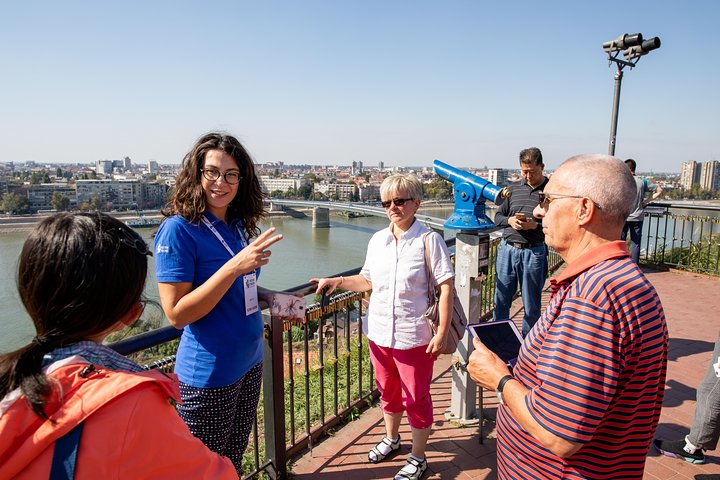
From this vantage point, you will enjoy breathtaking views over the Danube River and the city of Novi Sad.
· 30 min
- 8
Novi Sad
Novi Sad, Serbia's second-largest city, presents a typical Central European appearance and holds a proud history as the cultural and intellectual heart of Serbs within the Austro-Hungarian Empire, earning it the moniker 'Serbian Athens.'
Key sights include the Museum of Vojvodina, Dunavski Park (the city's largest green space), and the beautiful Neo-Romantic Serbian Orthodox Bishop's Palace.
We will also visit the 18th-century Serbian Orthodox Cathedral of St. George, featuring a valuable iconostasis painted by the renowned Serbian artist Paja Jovanović.
Continuing along the main street, admire the 18th and 19th-century architecture, and browse the numerous cafes and restaurants, leading us to Liberty Square, the city's central hub.
Here, you'll find the Town Hall, the Roman Catholic Cathedral, the Finance Palace, and the Neo-Classical Vojvodina hotel, the city's oldest.
Finally, we'll pass the Serbian National Theatre and reach the city Synagogue, a stunning example of Hungarian Secession architecture and one of Europe's largest preserved synagogues.
Following the guided tour, you will have free time to explore Novi Sad at your leisure.
Consider your guide's recommendations for a traditional Serbian lunch (at your own expense), indulge in some shopping, visit the Museum of Vojvodina, or simply wander through the charming streets.
At the designated time, we will re-board the vehicle for our return journey to Belgrade.
· 3 h
- 9
Belgrade
Your tour concludes with transportation back to your hotel or accommodation in Belgrade.
We anticipate arriving in the afternoon, marking the end of our services.
· Non-stop passage
 Top pick
 Selling fast