- 1
Notre Dame Cathedral of Saigon
Built in the late 1880s by French colonists, Saigon Notre Dame Cathedral stands as one of the few remaining strongholds of Catholicism in predominantly Buddhist Vietnam.
Located in Paris Square, the cathedral was named Notre Dame after the installation of the statue ‘Peaceful Notre Dame’ in 1959.
In 1962, the Vatican granted it Basilica status, officially naming it Saigon Notre-Dame Cathedral Basilica.
Standing nearly 60 meters tall, the cathedral showcases distinctive neo-Romanesque architecture, featuring an all-red brick facade (imported from Marseille), stained glass windows, and two bell towers with six bronze bells that still ring today.
It is set within a peaceful garden in the heart of Ho Chi Minh City's District 1.
· 10 min
- 2
Saigon Central Post Office
The Central Post Office in Ho Chi Minh City is a beautifully preserved relic from the French colonial era, arguably the grandest post office in Southeast Asia.
Situated next to Notre Dame Cathedral, these two cultural sites can be visited together, allowing visitors to envision life in Vietnam during the Indochinese Empire.
Designed by Alfred Foulhoux, the building features characteristic arched windows and wooden shutters, reflecting its late 19th-century origins.
· 30 min
- 3
The Independence Palace
Independence Palace served as the headquarters for Vietnamese General Ngo Dinh Diem until his assassination in 1963.
It gained global historical significance in 1975 when a North Vietnamese Army tank breached its main gate, marking the end of the Vietnam War.
Today, it is an essential visit for tourists in Ho Chi Minh City, preserved as a time capsule from 1975.
The grounds display two of the original tanks used in the palace's capture.
The palace was also the residence and workplace of the French Governor of Cochin-China and features lush gardens, secret rooms, antique furnishings, and a command bunker.
It continues to host significant events in Ho Chi Minh City, including APEC summits.
· 45 min· Admission included
- 4
War Remnants Museum
The War Remnants Museum in Ho Chi Minh City first opened its doors to the public in 1975.
Formerly known as the ‘Museum of American War Crimes’, it serves as a stark reminder of the protracted and brutal Vietnam War.
The museum exhibits graphic photographs and American military equipment, including a helicopter with rocket launchers, a tank, a fighter jet, and a single-seater attack aircraft.
Visitors can also see a 6,800kg conventional bomb, representative of the weaponry used by American troops against the Vietnamese between 1945 and 1975.
· 45 min· Admission included
- 5
The Secret Weapons Cellar
Hidden amidst the bustling streets of Ho Chi Minh City, at 287/70 Nguyen Dinh Chieu Street, District 3, lies a humble house preserving a significant piece of history: the secret weapon bunker of the Biet Dong Sai Gon.
This special unit of the Vietnam People's Army operated during the Vietnam War and used this site to conceal over two tons of weaponry in preparation for the 1968 Tet Offensive attack on the Independence Palace.
· 45 min· Admission included
- 6
People's Committee Building
The People’s Committee Building in Saigon, located in central Ho Chi Minh City, showcases well-preserved French colonial architecture amidst spacious gardens.
Originally constructed as a hotel in 1898 by French architect Gardes, it now functions as the city hall and is one of the city’s most iconic landmarks.
Situated at the end of the Nguyen Hue walking promenade, the building complex comprises three structures adorned with embossed statues of animals and people, intricate wall bas-reliefs, and a statue of Ho Chi Minh in front of the main edifice.
The building is particularly stunning when illuminated by LED lights in the evening.
· 30 min
- 7
Saigon Opera House (Ho Chi Minh Municipal Theater)
The Saigon Opera House in Ho Chi Minh City is an elegant colonial structure located at the intersection of Le Loi and Dong Khoi Streets in District 1, near Notre Dame Cathedral and the Central Post Office.
This restored, three-story theater, with a seating capacity of 800, was built in 1897.
It hosts a variety of performances, including opera, ballet, musical concerts, Vietnamese traditional dance, and plays.
Performance schedules are advertised around the building, and information is available at the nearby state-operated tourist information center.
· 30 min
- 8
Ba Thien Hau Temple
Ba Thien Hau Temple in Saigon is a Buddhist temple dedicated to Mazu, the Chinese sea goddess believed to protect and rescue sailors and seafarers by flying on a mat or cloud.
Mazuism integrates traditions and beliefs from both Taoism and Buddhism, forming a unique syncretic faith.
The temple is situated in 'Cholon' (Chinatown) in District 5, approximately a twenty-minute drive from the city center.
· 30 min
- 9
Phố Tau Sai Gon (Chợ Lớn Quận 5)
Ho Chi Minh City’s Cholon, Vietnam’s largest Chinatown, dates back to 1778 and holds significant historical and cultural importance.
Chinese minorities sought refuge here from the Tay Son dynasty and subsequently rebuilt the area twice after attacks, with a substantial loss of life during attempts to escape by boat.
Survivors settled and began trading Chinese goods. During the Vietnam War, Cholon thrived as a black market for US soldiers dealing in American military supplies.
Today, Cholon is a popular destination for tourists, attracting many visitors from Taiwan and China.
The area showcases classical Chinese architecture and numerous Chinese restaurants.
Binh Tay Market, at the heart of Cholon, is a bustling and somewhat chaotic marketplace with narrow aisles selling a wide variety of goods. While the product selection might not always meet expectations compared to other Ho Chi Minh City markets, the primary allure of Cholon lies in its authentic, centuries-old Chinese atmosphere, especially vibrant at night.
· 1 h
- 10
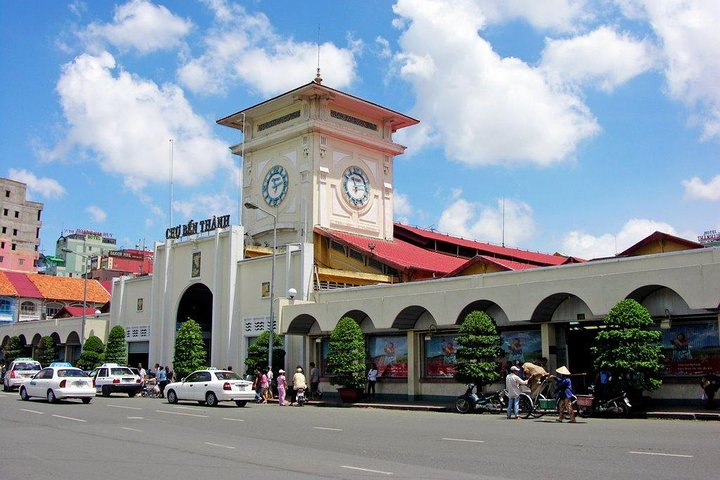
Ben Thanh Market
Ben Thanh Market, located in Ho Chi Minh City's District 1, is an excellent place to purchase local handicrafts, branded items, Vietnamese art, and souvenirs.
Inside the market, food stalls offer a taste of Vietnamese hawker-style cuisine, and you can find refreshments to escape the heat of bargaining.
The market is large and can be challenging to navigate, and it's best avoided during the hottest part of the day, but it is certainly worth exploring.
As night falls, restaurants surrounding the market come alive, creating a vibrant street scene filled with the aromas of wok-fried noodles, barbecued fish, and meats.
As one of Saigon’s oldest landmarks, Ben Thanh Market provides an authentically Vietnamese atmosphere.
· 30 min
 Top pick