- 1
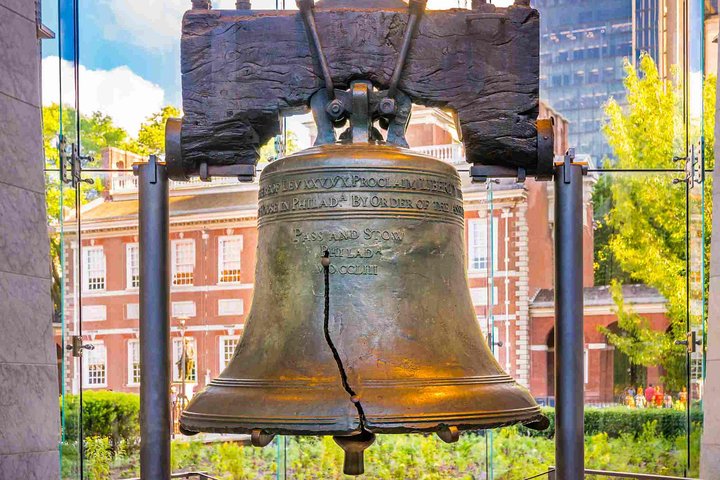
Liberty Bell Center
Join us as we visit The Liberty Bell, arguably the most renowned symbol of American Liberty within the National Historic Park.
During peak tourist season, lines for this iconic symbol of American Independence can extend significantly, often taking close to an hour to navigate.
Our historians will provide you with essential information about The Liberty Bell's creation and its rise to an icon of liberty, presented from outside the Liberty Bell pavilion.
Clear and detailed directions will be provided for entering the interior should you wish to spend an additional hour upon your return.
Commissioned in 1752, the bell famously cracked on its first test ring. It was recast two years later by local craftsmen John Pass and John Stow with the inscription, "Proclaim LIBERTY Throughout all the Land unto all the Inhabitants Thereof," a biblical quote referencing the jubilee for the freeing of enslaved persons and the forgiveness of debts every fifty years.
· Non-stop passage
- 2
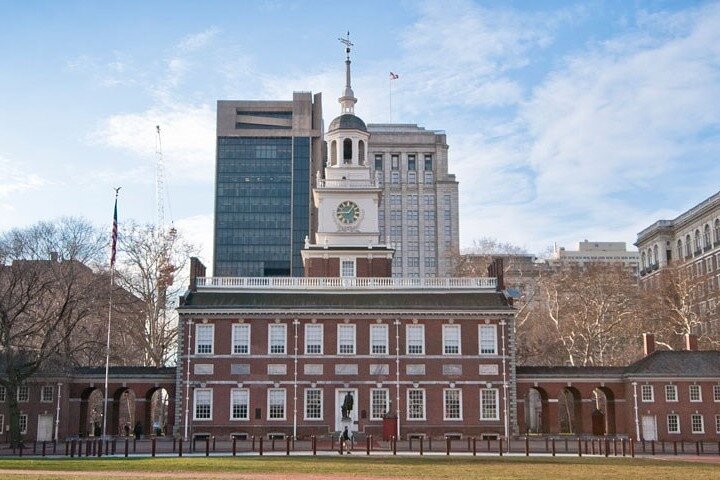
Independence Hall
We will visit Independence Hall, the historic building where both the United States Declaration of Independence and the United States Constitution were debated and adopted.
As a vital symbol of American democracy and the founding of the United States, the Independence Hall complex is a major tourist attraction.
It requires free timed entry passes and an additional recommended two hours for exploring the interior chambers of the complex.
We will keep your tour moving efficiently, focusing on the most important highlights and significant aspects of the structure, with straightforward instructions for further exploration should you choose.
Depending on crowds and potential closures, we will make a brief stop inside the East Wing of the Independence Hall Complex, the oldest and most historic part of the building, which served as the Supreme Court Chambers when Philadelphia was the nation's capital.
· Non-stop passage
- 3
The President's House
We will visit America's first "White House," which served as the residence for Presidents George Washington and John Adams during the period when Philadelphia was the capital of the United States from 1790 to 1800.
Foreign dignitaries, members of Congress, and the Senate frequently visited The President's House for both official and unofficial matters.
Benedict Arnold also resided in the structure as Military Governor of Philadelphia after the British evacuated the city during the American War for Independence.
· Non-stop passage
- 4
Congress Hall
We will visit Congress Hall, a historic building that hosted two presidential inaugurations (Washington and Adams).
It served as the home of the U.S. Congress from 1790 to 1800, during the time Philadelphia was the capital of the United States.
· Non-stop passage
- 5
Franklin Court
We will visit Franklin Court, a complex of museums, structures, and historic sites within Independence National Historical Park.
This was the home of Benjamin Franklin during his participation in the Constitutional Convention.
We will discuss the life and times of one of America's most prolific figures and statesmen, Benjamin Franklin.
He famously said when contemplating revolution against the British Crown, "Gentlemen we must hang together, or surely we will all hang separately."
· Non-stop passage
- 6
New Hall Military Museum
We will visit the site of America's first Pentagon, where American military strategy and intelligence were formulated during the American Revolution.
· Non-stop passage
- 7
Benjamin Franklin Museum
We will discuss the life and times of American Patriot Benjamin Franklin, covering his electrical experiments, printing and publishing endeavors, and his career as a statesman.
· Non-stop passage
- 8
B. Free Franklin Post Office
We will visit the Benjamin Franklin Post Office & Museum, the only Colonial-themed post office operated by the United States Postal Service.
It offers a living portrayal of a past Colonial lifestyle and is the only active post office in the United States that does not fly the American flag (as there was no flag in 1775 when Benjamin Franklin was appointed Postmaster General).
The postmark "B. Free Franklin" is still used to cancel stamps.
The museum on the second floor displays postal history and memorabilia.
· Non-stop passage
- 9
Carpenters' Hall
We will visit Carpenters' Hall, the location of the First Continental Congress in 1774.
During three nights in December 1775, Benjamin Franklin met secretly with John Jay, Fancis Daymon, and the French spy Julien Achard de Bonvouloir at this site.
These meetings eventually led to negotiations for French support of the colonists, aid that was crucial for the American victory in the Revolutionary War.
During the winter of 1777, British forces occupying the American capital during the War for Independence occupied this building.
· Non-stop passage
- 10
First Bank of the United States
We will visit the First Bank of the United States.
Championed by Alexander Hamilton, the first Secretary of the Treasury, the First Bank of the United States was established in 1797 and is notable for its architectural design.
· Non-stop passage
- 11
Second Bank of the United States
Modeled after Alexander Hamilton's First Bank, the Second Bank of the United States was chartered by President James Madison in 1816 and lost its charter under President Andrew Jackson in 1834.
Here, we will discuss Alexander Hamilton and Andrew Jackson, including famous duels fought by both men, among other topics.
· Non-stop passage
- 12
American Philosophical Society Museum
The American Philosophical Society, founded in 1743 by Benjamin Franklin two years before the University of Pennsylvania, maintains a close connection with the university.
Early members included George Washington, John Adams, Thomas Jefferson, Alexander Hamilton, Thomas Paine, David Rittenhouse, Nicholas and Owen Biddle, Benjamin Rush, and James Madison, among others.
As we walk by, we will discuss Franklin, the University of Pennsylvania, and America's first surgical center located adjacent to the structure.
· Non-stop passage
- 13
Library Company of Philadelphia
Founded by Benjamin Franklin in 1731, the Library Company is the world's first institution to lend materials to the public.
As we walk by, we will discuss the history of the site, its historic location, and the early statesmen who frequented it.
· Non-stop passage
- 14
Todd House
We will see the home of future First Lady Dolley Madison, where she resided with her first husband, John Todd, from 1791 to 1793.
Built in 1775, the Dolley Todd House site offers a glimpse into the lifestyle of the middle class in 18th-century Philadelphia.
· Non-stop passage
- 15
Independence Visitor Center
Check-in and an introduction to revolutionary history at the commencement of our historic walking tour.
· Non-stop passage
- 16
Grim Philly Twilight Tours
Every guide holds a history degree.
Most guides are history teachers and American History Professors.
· Non-stop passage
 Top pick
 Top pick
 Free cancellation
 Top pick
 Top pick
 Top pick
 Top pick
 Free cancellation
 Top pick
 Top pick
 Selling fast