- 1
Old Fortress Corfu
Your accredited guide will greet you at the Old Fortress, by the Schulemburg statue.
After an exterior overview of the monument, you'll proceed into the historical center.
· Non-stop passage
- 2
Spianada Square
Spianada Square, the city's most prominent landmark, derives its name from the Venetian for 'open flat area' and is reputed to be the largest square in the Balkans.
The Liston, part of the square, features some of Corfu's finest cafes and restaurants.
The French transformed Spianada into a public space; previously, it was a vast open area used for defense.
Cricket matches are held on the Esplanade, the only venue for this sport in Greece.
· Non-stop passage
- 3
Corfu Museum of Asian Art
The Palace of Saint Michael and Saint George is situated in the northern part of Corfu's historical town center square.
It stands as the most significant structure from the British rule period (1814-1864), built at the request of Sir Thomas Maitland, the British Lord High Commissioner, to serve as his residence and administrative headquarters.
Today, it houses the Corfu Museum of Asian Arts, Greece's sole institution dedicated to the art and antiquities of the Far East and India.
Established in 1928, its collection of approximately 15,000 Asian art pieces is globally recognized, with rare items featured in international exhibitions.
· Non-stop passage
- 4
Church of Saint Spyridon
During our exploration, we will also visit the Church of Saint Spyridon, the island's patron saint and a revered miracle worker.
· 15 min
- 5
Town Hall Square
As we wander through the narrow streets, we'll pass by Corfu's Town Hall Square, once the exclusive Venetian neighborhood with its opera house and surrounding villas.
We will admire the Town Hall building, initially a club for noblemen, which later hosted the Noble Theatre of Saint Giacomo of Corfu in 1720 before becoming the Town Hall in 1903.
· 30 min
- 6
Jewish Synagogue of Corfu
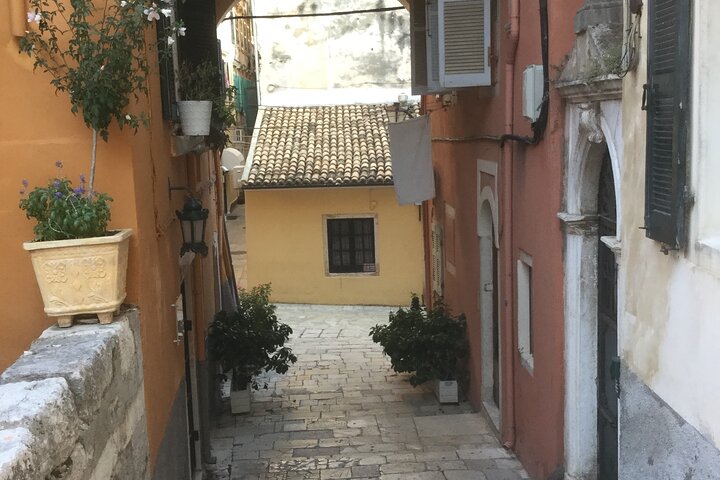
The Jewish quarter, known today in Greek as Evraiki, was the old Venetian "ghetto" located in the southeastern part of the city, near the Venetian fortifications.
It was characterized by narrow alleyways lined with aged, multi-story houses, reminiscent of Venice.
The ghetto's urban integrity was compromised by bombings during World War II.
· Non-stop passage
 Top pick
 Top pick
 Top pick