- 1
Phnom Penh
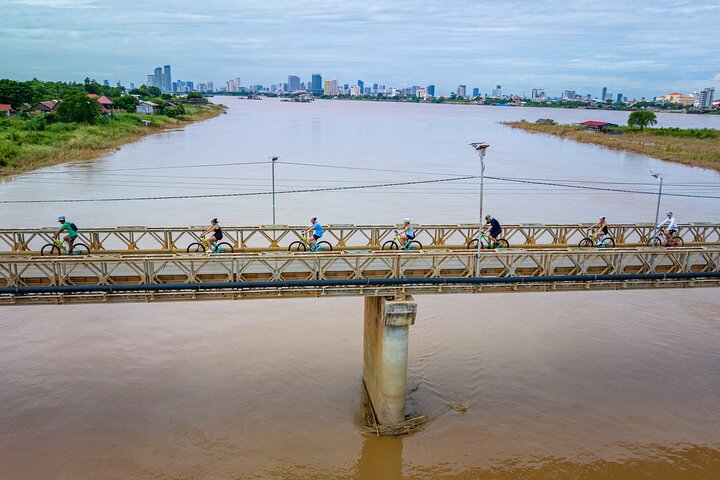
Begin your journey in Phnom Penh, Cambodia’s vibrant capital, situated at the confluence of the Mekong and Tonlé Sap rivers. Once a significant center for both the Khmer Empire and French colonialists, its walkable riverfront is adorned with parks, restaurants, and bars. Discover the ornate Royal Palace, the Silver Pagoda, and the National Museum, which showcases artifacts from across the country. At the heart of the city lies the impressive, art deco Central Market.
· 20 min
- 2
Royal Palace
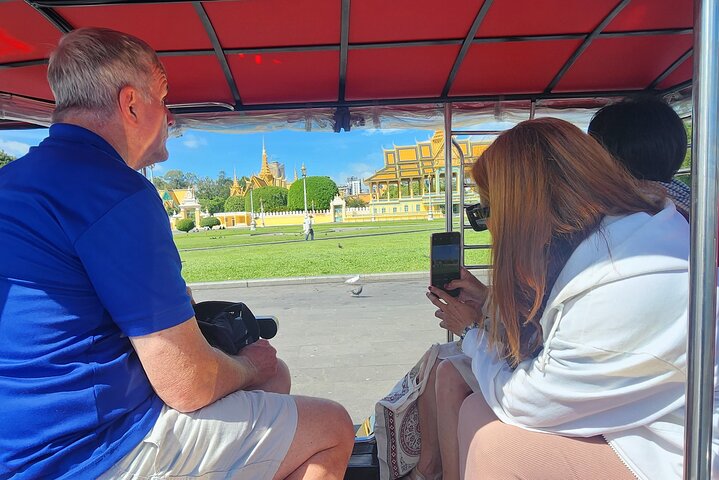
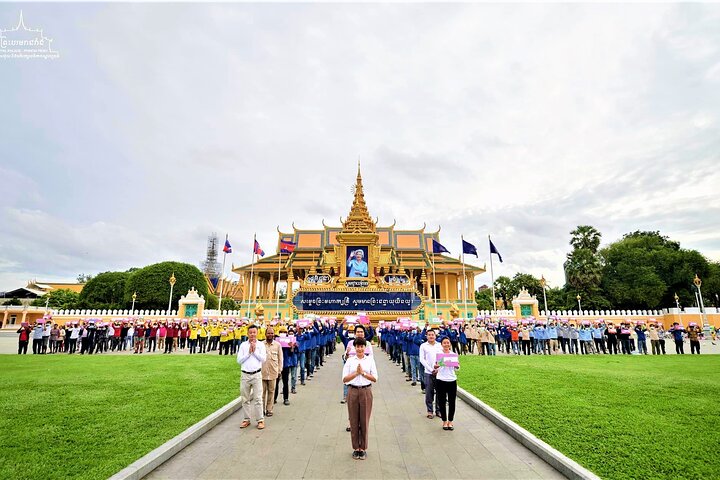
The Royal Palace stands as one of Phnom Penh's most recognizable landmarks. Construction commenced in 1886 after King Norodom moved the royal capital to Phnom Penh, and it was completed before World War I. To this day, the palace remains the primary residence of the King of Cambodia.
· 1 h· Admission included
- 3
Silver Pagoda
The exquisite Silver Pagoda is located adjacent to the Royal Palace in Phnom Penh. With its beautiful garden, it offers a serene escape from the bustling streets of Cambodia's capital. The interior of the pagoda is equally breathtaking, featuring countless handcrafted silver tiles adorning the floor. It is also known as the Temple of the Emerald Buddha due to its primary Buddha statue, crafted from emerald or baccarat crystal.
· 1 h· Admission included
- 4
Tuol Sleng Genocide Museum
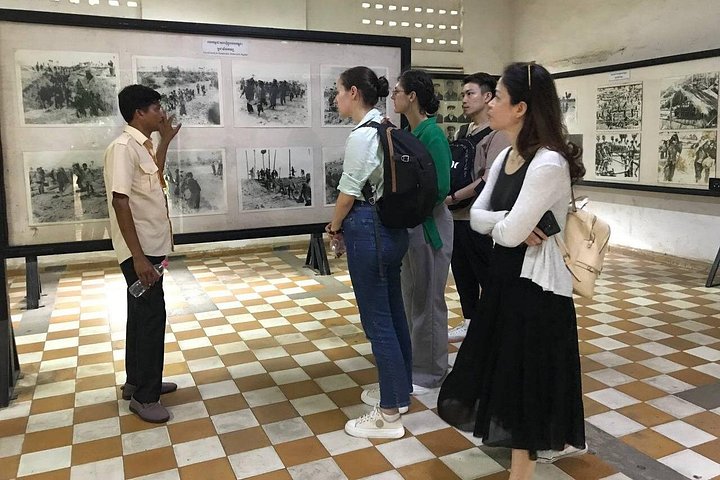
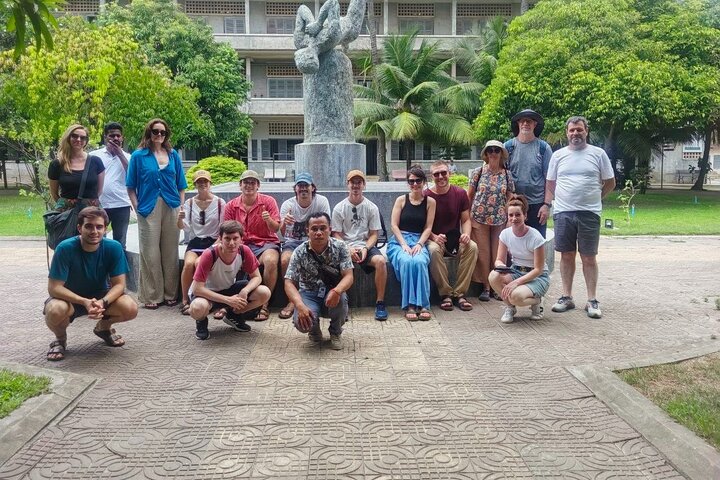
The Tuol Sleng Genocide Museum is a poignant museum in Phnom Penh, the capital of Cambodia, dedicated to documenting the Cambodian genocide. This site was formerly a secondary school, repurposed as Security Prison 21 (S-21) by the Khmer Rouge regime from their rise to power in 1975 until their fall in 1979. Between 1976 and 1979, an estimated 20,000 individuals were imprisoned at Tuol Sleng, though the exact number remains unknown. The name 'Tuol Sleng' translates to 'Hill of the Poisonous Trees' or 'Strychnine Hill'. While Tuol Sleng was one of at least 150 torture and execution centers established by the Khmer Rouge, some sources indicate there were as many as 196 such centers. On July 26, 2010, the Extraordinary Chambers in the Courts of Cambodia convicted the former chief of Tuol Sleng Prison, Kang Kek Iew (alias Duch), for crimes against humanity and grave breaches of the 1949 Geneva Conventions, sentencing him to life imprisonment.
· 1 h 30 min· Admission included
- 5
Choeung Ek Genocidal Center
Choeung Ek is the site of a former orchard and mass grave for victims of the Khmer Rouge, who were executed between 1975 and 1979, located approximately 17 kilometers south of Phnom Penh, Cambodia. It is the most well-known of the sites referred to as 'The Killing Fields,' where the Khmer Rouge regime was responsible for the deaths of over one million people during the same period. Following the fall of the Khmer Rouge regime, mass graves containing 8,895 bodies were discovered at Choeung Ek. Many of the deceased were former political prisoners held at the Tuol Sleng detention center and other Cambodian detention facilities. Today, Choeung Ek serves as a memorial, marked by a Buddhist stupa. The stupa features acrylic glass sides and houses over 5,000 human skulls. Some lower levels are accessible during the day, allowing visitors to see the skulls directly. Many skulls show evidence of shattering or smashing.
· 1 h 30 min· Admission included
- 6
Wat Phnom
Wat Phnom is situated atop a tree-covered knoll, 27 meters high, and is the only hill in the city. According to local legend, the first pagoda on this site was built in 1373 to house four Buddha statues that were discovered by a woman named Penh after being washed ashore by the Mekong River. The main entrance to Wat Phnom is accessed via a grand eastern staircase, flanked by guardian lions and naga (serpent) balustrades.
· 1 h· Admission included
- 7
Statue of King Father Norodom Sihanouk
The Statue of King Father Norodom Sihanouk is a significant bronze memorial located in the heart of Phnom Penh's Independence Square.
· 30 min· Admission included
- 8
Independence Monument
The Independence Monument in Phnom Penh, the capital of Cambodia, was erected in 1958 to commemorate Cambodia's independence from France in 1953. It is positioned at the intersection of Norodom Boulevard and Sihanouk Boulevard in the city center. The monument is designed as a lotus-shaped stupa, reminiscent of the style found at Khmer temples like Banteay Srei and other historical Khmer sites. Designed by Cambodian architect Vann Molyvann, the Independence Monument stands 37 meters tall. During national celebrations, it becomes the focal point of activities. A ceremonial flame on an interior pedestal is often lit by a royal or high-ranking official on these occasions, and floral tributes are placed along the stairs. The Independence Monument attracts numerous foreign tourists and locals annually. Behind the monument lies the Norodom Sihanouk Memorial, constructed in 2013.
· 30 min· Admission included
- 9
Wat Ounalom
Wat Ounalom, established in 1422, is one of Phnom Penh's five original monasteries. It previously housed the Institute Bouddhique and its library. Located on the riverfront, approximately 250 meters north of the Royal Palace and facing the Tonle Sap River, this pagoda serves as the headquarters for one of Cambodia's most revered Buddhist patriarchs. Ounalom Pagoda is a key tourist attraction in Phnom Penh, a city ideal for vacationers with its numerous pagodas, parks, monuments, and museums. A visit to Ounalom Pagoda promises a delightful experience during your trip.
· 45 min· Admission included
- 10
Central Market
The Central Market, a large dome-shaped market with four expansive wings branching out into numerous stalls, was constructed in 1937. Originally designed by Jean Desbois (1891-1971), its construction was overseen by French architect Louis Chauchon (1875-1945) and engineer Wladimir Kandaouroff. Situated in Phnom Penh, Cambodia's capital, it was reportedly the largest market in Asia upon its opening in 1937 and continues to operate as a market today. Between 2009 and 2011, it underwent a US$4.2 million renovation funded by the French Development Agency. This distinctive Art Deco building is a landmark of Phnom Penh. Prior to 1935, the area was a lake that collected runoff during the rainy season. The lake was drained, and construction began in 1935. Since its completion in 1937, flooding around the market during the wet season has persisted, serving as a remnant of the former lake.
· 30 min· Admission included
 Top pick
 Top pick
 Free cancellation
 Top pick
 Top pick
 Top pick
 Top pick
 Top pick