- 1
Walled City of Cartagena
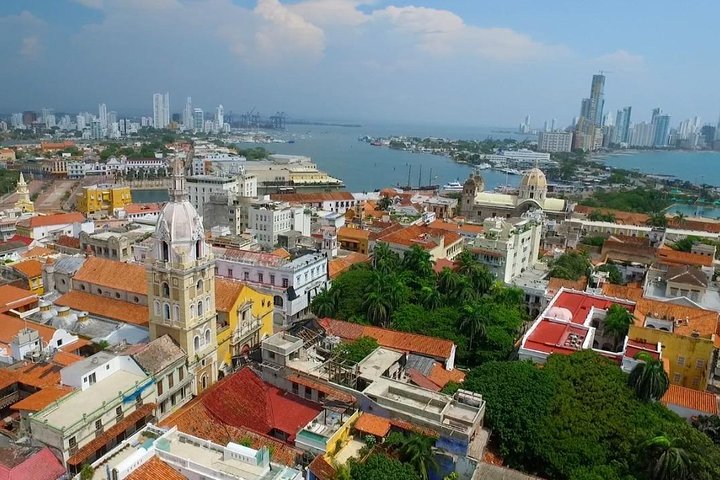
Begin your journey with a Private Walking Tour of Cartagena, designed to immerse you in the unique spirit of this UNESCO World Heritage site. The legendary Walled City beckons with its cobblestone lanes, romantic plazas, and ancient fortifications. This engaging walking tour will unveil captivating narratives of pirates, colonial battles, and independence struggles, all interwoven with Cartagena's vibrant Caribbean essence.
Your expert local guide will illuminate the city's prominent landmarks and hidden gems, sharing stories that bring to life the rich tapestry of Indigenous, African, and Spanish influences. Discover the colorful folklore, religious traditions, and lively music that define the city's atmosphere. Admire the picturesque colonial architecture, balconies adorned with blooming flowers, and the enticing aromas of tropical fruits and street food that embody Cartagena's charm.
· 10 min
- 2
Camellon de los Martires
Your guide will greet you at the Camellón de Los Mártires, a public space steeped in history, offering a warm welcome and a brief overview before commencing your exploration.
This location marks the true beginning of Cartagena's story, predating the Spanish arrival and the construction of its famous walls. Your guide will introduce you to the indigenous civilizations that inhabited this coast for centuries, highlighting their culture, their deep connection to the land, and the enduring legacy they left in the city's language, cuisine, and people. This distinct starting point sets a unique tone for the discoveries that follow.
· 10 min
- 3
Monumento Torre del Reloj
Next, we proceed to Cartagena's iconic "Golden Key" – the renowned Clock Tower – and enter Plaza del Ecuador, formerly known as Plaza del Esclavo. This square signifies the commencement of the city's historical slave route, which we will follow along the ancient Porto Carrero and Candilejo streets. Before continuing, we'll be greeted by a representation of Pedro de Heredia, the city's founder, whose presence continues to watch over Cartagena's bustling entrance.
· 10 min
- 4
Plaza De Los Coches
The Plaza de Los Coches presents a striking juxtaposition of history within a single location. Today, it is one of Cartagena's most photographed spots, with its colonial arcades, horse-drawn carriages, and colorful facades attracting global visitors. However, this square was once the largest slave market in the Americas, where countless African men, women, and children were traded upon their arrival in the New World.
At the heart of the square stands the monument to Pedro de Heredia, the Spanish conquistador credited with founding Cartagena in 1533. Your guide will also unveil his intriguing connection to Miguel de Cervantes, the celebrated author of Don Quixote, and how this relationship left an unexpected imprint on Colombian literary history.
This site compels reflection on the dual realities of the city: the undeniable beauty it has achieved and the profound suffering upon which it was built.
· 5 min
- 5
Monumento a Pedro de Heredia
The Plaza de Los Coches presents a striking juxtaposition of history within a single location. Today, it is one of Cartagena's most photographed spots, with its colonial arcades, horse-drawn carriages, and colorful facades attracting global visitors. However, this square was once the largest slave market in the Americas, where countless African men, women, and children were traded upon their arrival in the New World.
At the heart of the square stands the monument to Pedro de Heredia, the Spanish conquistador credited with founding Cartagena in 1533. Your guide will also unveil his intriguing connection to Miguel de Cervantes, the celebrated author of Don Quixote, and how this relationship left an unexpected imprint on Colombian literary history.
This site compels reflection on the dual realities of the city: the undeniable beauty it has achieved and the profound suffering upon which it was built.
· Non-stop passage
- 6
Portal de Los Dulces
Few locations in Cartagena resonate with as much living history as the Portal de Los Dulces. For over three centuries, this historic arcade at the entrance to the Walled City has been a space dominated by women. Initially, it was a place where enslaved Africans sold sweets to survive and gain a measure of economic independence within a harsh system. Later, their descendants continued this tradition, inheriting not only the recipes but also the right to this significant space.
· 10 min
- 7
Plaza de la Aduana
During the zenith of the Spanish empire, the Plaza de La Aduana was the epicenter of power in Cartagena. Serving as the administrative and commercial hub of the colony, it was here that royal edicts were proclaimed, taxes were collected, and the immense wealth extracted from the Americas was processed before being sent to Spain. Crucially, it was also a primary site for the trafficking of enslaved Africans, whose forced labor generated the very wealth this square was designed to manage.
Today, the Plaza de La Aduana remains one of the Walled City's most architecturally significant areas. The Municipal Hall, one of Cartagena's oldest civic structures, anchors the square, its colonial facade largely preserved since the era when the city stood as the most vital port in the Spanish empire.
Your guide will bring both historical layers to life: the magnificence of the structures built here and the human cost associated with their construction.
· 10 min
- 8
Museo de Arte Moderno Cartagena
Nestled in a beautiful corner of the Walled City, the Museum of Modern Art of Cartagena stands as a quiet yet powerful tribute to the creative spirit of Caribbean and Latin American artistic traditions. Housed within a restored colonial building that once served as the city's customs warehouse, the museum showcases a remarkable collection of works from the 1950s onwards. These pieces capture the region's history—its beauty, its tensions, and its complexities—through the lens of its artists.
While we won't be entering the museum today, pausing before its facade serves as a reminder that Cartagena is more than just a city of conquest and commerce; it is a place that has consistently expressed itself through art, color, and creativity. These qualities are evident on every wall, balcony, and street corner in the surrounding neighborhood.
· 10 min· Admission not included
- 9
Plaza de San Pedro Claver
In a city built upon the labor of enslaved Africans, one individual took a profoundly different stance. Pedro Claver, a Spanish Jesuit priest who arrived in Cartagena in the early 17th century, dedicated his life to upholding the dignity and providing care for the thousands of enslaved people who passed through this port in chains. He adopted the title he chose for himself: "Slave of the Slaves."
The church, monastery, and museum bearing his name serve as a monument to this legacy. The architecture itself represents some of the finest examples of colonial religious construction in the Americas. However, it is the compelling story of the man behind these walls that makes this stop one of the most emotionally impactful moments of the tour.
Pedro Claver was the first person to be canonized in the New World in 1888. Today, his remains are interred within the church, and the monastery, which was his home for decades, has been preserved as a museum and recognized as a Headquarters of Human Rights.
· 10 min
- 10
Sanctuary of Saint Peter Claver
Cartagena's Cathedral of San Pedro Claver (Iglesia de San Pedro Claver) commemorates the life of Saint Pedro Claver, recognized as one of the earliest human rights advocates in the Americas. The cathedral's austere stone facade hints at a serene interior, where visitors can pay their respects to the saint's remains, visible through a gilded glass case.
· 5 min· Admission not included
- 11
Catedral Santa Catalina de Alejandria
Our next stop on this Private Walking Tour in Cartagena is the magnificent Cathedral of Santa Catalina de Alejandría, one of Colombia's oldest and most iconic churches. Constructed between 1577 and 1612, this impressive edifice is a prime example of colonial religious architecture in the Caribbean. Its distinctive bell tower and elegant stone facade have become one of Cartagena's most photographed landmarks.
Within the cathedral, centuries of history are preserved, featuring religious art, original altars, and narratives from the city's colonial past. It also served as a vital spiritual and social center for Cartagena's inhabitants throughout the years. Standing before this grand building, you will sense the city's layered history—from Spanish rule to its fight for independence—reflected in its architecture and legends. It is an essential stop on any walking tour of Cartagena's Walled City.
· 10 min
- 12
Plaza de Bolivar
Are you intrigued by the exploits of pirates and corsairs? We will recount their tales as we visit a Bastion, offering a glimpse into Spanish military constructions and strategies. We then continue to Plaza Bolívar, established in honor of the precursor to Independence, providing a place for refreshment.
· 10 min
- 13
Palacio de La Inquisicion
The historic Palace of the Inquisition stands as one of Cartagena's most striking and infamous landmarks. Constructed in the early 17th century, this colonial mansion once housed the Holy Office of the Inquisition in the city. During a somber period of colonial history, individuals accused of heresy, witchcraft, or blasphemy were interrogated and tried within these walls.
Today, the meticulously preserved building functions as a museum, offering insights into the Inquisition's role in Cartagena. Visitors can view original instruments of torture and explore exhibits detailing the city's colonial past. Its elegant baroque balconies, stone archways, and serene courtyard present a stark contrast to the grim events that transpired here, making it a powerful and thought-provoking stop that reveals another facet of Cartagena's complex history.
· 10 min
- 14
Palacio de La Inquisicion
We pass by the Palace of Inquisition (Museo Histórico de Cartagena de Indias), a museum that was once the headquarters of the Spanish Inquisition. The museum displays a variety of artifacts, including torture devices, paintings, and pre-Columbian statues and ceramics.
· Non-stop passage
- 15
Museo del Oro Zenu
Long before Spanish galleons arrived on this coast in search of El Dorado, the Zenú people had perfected one of the most advanced goldworking traditions of the pre-Columbian era. The Museo del Oro Zenú, located in a beautifully restored colonial mansion on Plaza de Bolívar, brings this civilization to life through an exceptional collection of over 530 gold artifacts. Each piece is a testament to the artistry, spirituality, and ingenuity of the indigenous peoples of Colombia's Caribbean coast.
Among the collection's highlights is a pre-Hispanic golden jaguar, considered one of the most iconic pre-Columbian artifacts in the country. Additionally, bone carvings and textiles offer a comprehensive view of Zenú culture beyond its renowned metalwork.
Established in 1982 and offering free admission, the museum is one of Cartagena's most overlooked treasures. Situated just steps from Plaza de Bolívar, it provides a distinct perspective from the colonial narrative that often dominates the city's historical accounts.
· 5 min
- 16
Plaza Santo Domingo
Founded in 1534, merely a year after the city itself, the Iglesia de Santo Domingo is the oldest church in Cartagena and one of the oldest in Colombia. Its robust stone walls, marble altar, and imposing central nave have borne witness to nearly five centuries of the city's history, from the height of the Spanish empire through its independence and beyond.
What makes this stop particularly special is the vibrant contrast between the solemnity of the church and the lively atmosphere surrounding it. The Plaza de Santo Domingo, one of the most bustling squares within the Walled City, extends from the church's entrance, alive with outdoor cafes, street vendors, local musicians, and the spontaneous, unhurried energy that defines Cartagena.
As you approach, observe the bell tower: its slight asymmetry is not accidental. Local legend attributes its crookedness to the devil himself, who supposedly twisted it in frustration during construction. Your guide will share the complete story.
· 5 min
- 17
Baluarte de Santo Domingo
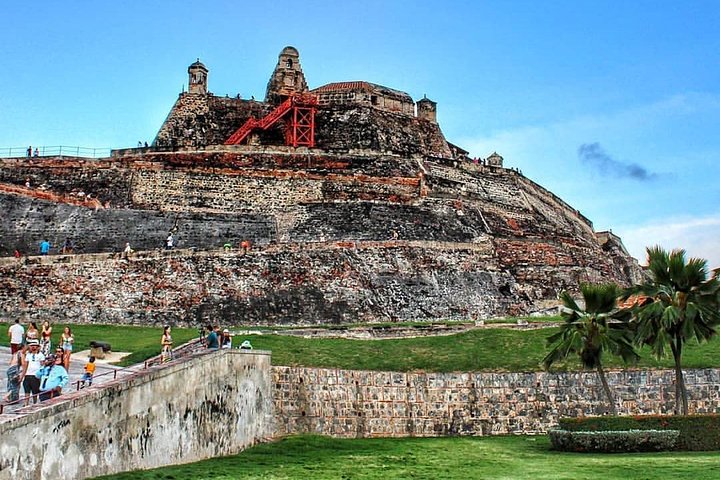
Standing at the base of one of Cartagena's most recognizable bastions, you are gazing upon the same stone walls that once protected the city from the most feared pirates and corsairs of the Caribbean. The Baluarte de Santo Domingo, erected by the Spanish in the 17th century, was a crucial component of the defensive system that rendered Cartagena's Walled City virtually impregnable, marking it as one of the most strategically designed fortifications in colonial Latin America.
From this vantage point, your guide will explain the interconnectedness of the entire wall system as a unified defense mechanism and why Cartagena—the wealthiest port in the Americas during the peak of the silver trade—required every inch of its formidable defenses.
· Non-stop passage
- 18
Baluarte de San Ignacio
From the Baluarte de San Ignacio, you are overlooking one of the most strategically critical points in Cartagena's legendary defensive network. Constructed to safeguard the entrance to the Bay of Souls—the natural harbor that made Cartagena the most coveted port in the Spanish empire—this bastion served as the final line of defense against the pirates, corsairs, and rival imperial forces that repeatedly attempted to seize the city by sea.
The walls before you are not mere decoration. Every angle, every cannon emplacement, and every stone was meticulously positioned with a singular objective: to make Cartagena unconquerable. For the most part, these defenses succeeded. French corsairs, English privateers, and the most formidable naval powers of the era all tested these walls, with most ultimately retreating in defeat.
Your guide will elaborate on how this bastion integrated with the broader network of fortifications, establishing Cartagena's defensive system as one of the greatest military engineering achievements in the Americas.
· 10 min
- 19
Plaza de la Proclamacion
Welcome to Plaza de la Proclamación, a square of immense historical significance in Cartagena. It was here, on November 11, 1811, that Cartagena boldly declared its independence from Spanish rule, becoming the first city in Colombia to do so. Surrounded by colonial-era buildings, including the Archbishop’s Palace, this plaza has been the backdrop for pivotal moments in the city's struggle for freedom.
Today, it remains a vibrant public space where locals gather, and historic monuments stand in tribute to the city’s revolutionary spirit. As you stand in this square, you will feel the resonance of Cartagena’s courageous past and witness the seamless blend of history and contemporary Caribbean life.
· 5 min
- 20
Parque centenario
Just a short distance from the bustling Walled City, Parque Centenario offers a moment of unexpected tranquility. This verdant urban park, one of Cartagena's most important green spaces and a remnant of the tropical dry forest that once covered this entire coastline, is situated on the grounds of the city's former historic railway station, serving as a reminder of a different era in Colombian history.
However, the true stars of this stop are its inhabitants. Look up into the trees to spot sloths moving with their characteristic unhurried grace. Iguanas bask in the sun along the pathways, and squirrels dart through the undergrowth. In the midst of a colonial city of half a million people, this small patch of urban forest has become a sanctuary for wildlife that has inhabited Cartagena far longer than its human residents.
It also provides the most welcome shade on the entire tour on a warm Caribbean afternoon.
· 10 min
- 21
Barrio Getsemani
Graffiti, culture, music, traditions, folklore, commerce, and architecture all come alive as we explore one of Getsemaní’s most vibrant cultural corridors. This lively street is known for its colorful umbrellas overhead—a symbol of local identity—stunning street art, and unique colonial architecture. It’s a perfect spot to feel the creative pulse and authentic spirit of Cartagena.
· 10 min
- 22
Plaza de La Trinidad
Getsemaní embodies the soul of the city, and Plaza de La Trinidad is where that soul beats most vibrantly. For centuries, this square has been the social, spiritual, and political heart of the neighborhood that housed the sailors, artisans, and freed enslaved people who built and sustained colonial Cartagena, yet were denied residence within its walls.
It was here, in 1811, that the people of Getsemaní took to the streets, demanding absolute independence from Spain—an act of popular rebellion that made Cartagena the first city in Colombia to declare independence. The square's church, the Iglesia de la Santísima Trinidad, bore witness to that moment, as it has to every chapter of this neighborhood's history since.
Today, the plaza remains precisely what it has always been: a gathering place. Every evening, locals fill the benches, children play, and the community reclaims its square with the same quiet defiance that has characterized Getsemaní for four centuries.
· 10 min
- 23
Enjoy this colorful and iconic street of Getsemaní in this Private Walking Tour
· 2 min
- 24
Here we will discuss Graffiti, Cafés, Blas de Lezo, Gabriel García Márquez, Mister Black, and Joe Arroyo.
· 10 min
- 25
No neighborhood in Colombia tells its story through its walls quite like Getsemaní. What began as an act of resistance—artists reclaiming crumbling facades in a neighborhood threatened by gentrification—has evolved into one of Latin America's most celebrated open-air galleries. It attracts muralists from across Colombia and the world, eager to leave their mark on these 400-year-old streets.
As you traverse Getsemaní, your guide will unveil the narratives behind the murals, as nothing here is purely decorative. The faces adorning the walls represent real individuals: community leaders, Afro-Colombian heroes, neighborhood elders, and figures from Cartagena's colonial past who were omitted from official histories and subsequently brought back to life by local artists. Every color, image, and wall carries a meaning rooted in the identity of a community that has fought—and continues to fight—to preserve the neighborhood it built.
· Non-stop passage
- 26
From expansive political murals on Calle Larga to the intricate, intimate artwork tucked away in doorways and stairwells, Getsemaní's street art is impossible to overlook. Your guide will highlight the details that often escape the notice of most visitors.
· Non-stop passage
- 27
Discover the iconic Plaza del Pozo in the Getsemaní neighborhood.
· 3 min
 Top pick
 Top pick
 Top pick
 Private tour
 Top pick
 Top pick
 Top pick
 Private tour
 Top pick
 Top pick
 Top pick
 Free cancellation
 Free cancellation
 Top pick
 Free cancellation
 Top pick
 Top pick